
DETACHED PREFABRICATED HOUSE AND NATURAL LIVING EXPERIENCE
For those who want to build an independent living space in rural areas or on their own land, traditional reinforced concrete methods are rapidly giving way to modular systems. As someone who has been involved in the installation phases of various projects in the field for years, there is a reality I have clearly observed: The operational burdens contained in traditional construction processes seriously wear out the investor. In a reinforced concrete building process, you face long stages such as weeks of excavation, tying iron to the foundation, striking molds, and pouring concrete. The setting time of concrete is directly dependent on weather conditions; construction stops on rainy or frosty days. However, when you choose a prefabricated house, these dependencies, which we call wet construction, disappear. While the foundation is being laid on site, computer-aided machines in the factory cut and prepare all the components of the house with millimeter precision. The high-strength iron profiles and metal parts that make up the main load-bearing skeleton arrive at the site as a package ready for assembly. Because the static structure of reinforced concrete buildings is rigid, the risk of cracking during a tremor is high. However, a prefabricated house woven with iron profiles absorbs the tremor energy by flexing. These systems, whose budget and delivery date are known, do not produce surprise costs.
SINGLE-STORY (DETACHED) PREFABRICATED HOUSE
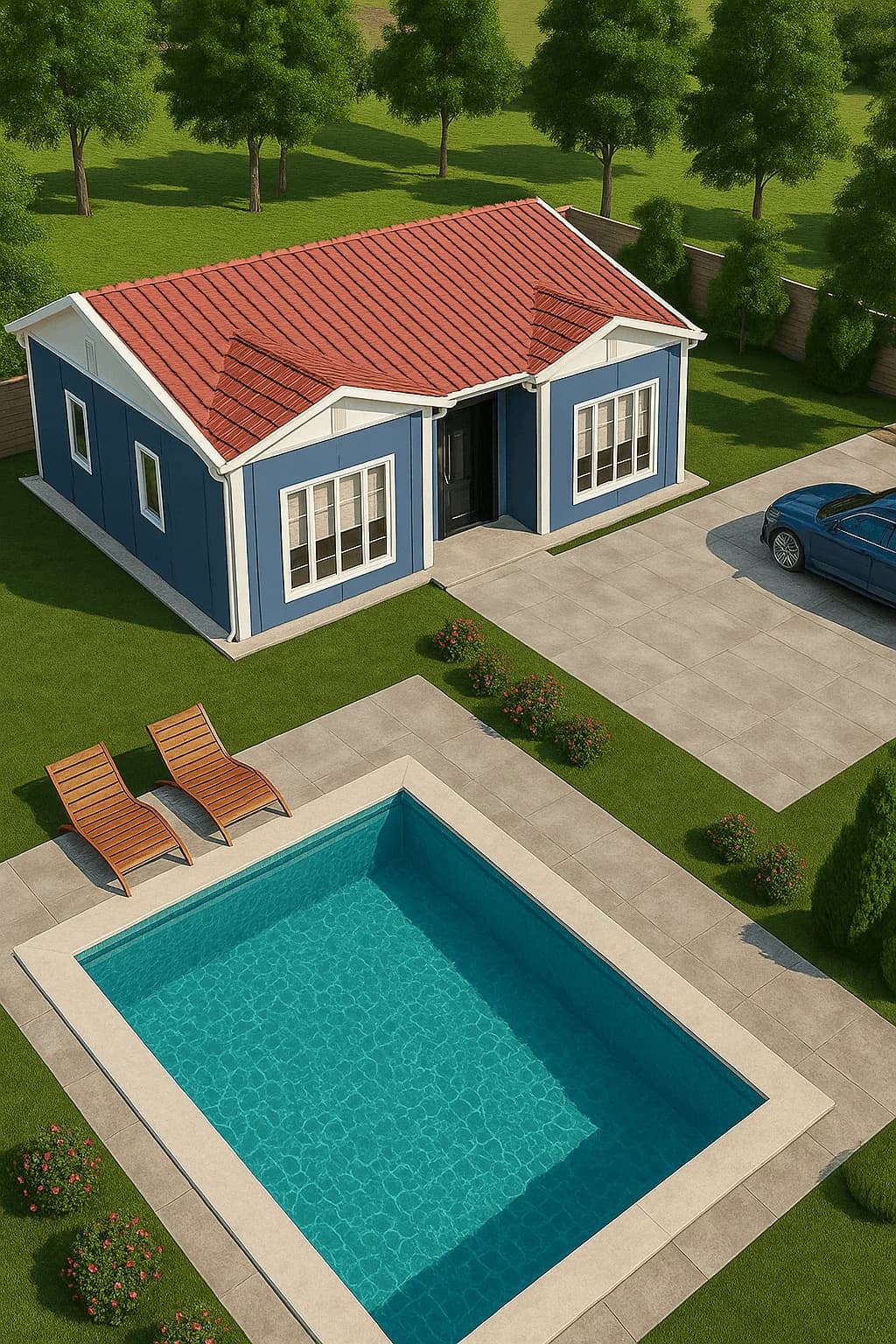
The horizontal architecture advantages of living on the same level as the ground make single-story models the most rational choice for those planning garden use. Built on a standard plinth concrete, a single-story prefabricated house shows maximum resistance against lateral wind loads and seismic movements because its center of gravity is close to the ground. The absence of a stair circulation area maximizes the net usable square meters inside. Since there is no other layer between the ground floor and the roof, heating and cooling systems bring the house to the ideal temperature much faster. By laying a waterproofing layer between the metal parts forming the chassis and the concrete, capillary moisture is prevented from climbing the walls. A trapezoidal sheet metal roof must definitely be used in the roof system. The trapezoidal sheet metal roof, thanks to its formed structure, quickly directs the water and prevents condensation, preventing the skeleton from rusting. Plaster cracks caused by settling on the ground over time in reinforced concrete houses are not experienced in these houses thanks to the flexible structure of the modular system.
TWO-STORY (DUPLEX) PREFABRICATED HOUSE
For users who want to obtain maximum square meters on narrow plots or have a crowded family structure, two-story duplex structures offer a perfect solution architecturally and in terms of engineering. In a two-story prefabricated house project, the lower floor is allocated to moving areas, while the upper floor is completely allocated to quiet areas. Waiting for the ceiling concrete to dry in the construction of a two-story building is a waste of time. In modular systems, as soon as the installation of the lower floor is finished, the intermediate floor chassis is placed and the installation of the upper floor is started on the same day. High-density acoustic filling materials that dampen vibration are placed between the thick iron profiles forming the intermediate floor. In this way, footsteps or the sound of pulling furniture are not transmitted to the lower floor. Statically, it is produced by making all analyses of wind speed and dynamic loads.
PREFABRICATED MOUNTAIN HOUSE
Establishing a living space in high-altitude terrains where geographical conditions are harsh and snow load increases requires serious static planning. It is often impossible for ready-mixed concrete mixers to climb the terrain. A prefabricated house, all parts of which are transported disassembled by trucks, is an alternative-free construction method for lands on mountain tops. Snow load is a vital parameter in the mountain house concept. The iron profiles carrying the roof are placed at more frequent intervals and must be covered with a trapezoidal sheet metal roof covering. The trapezoidal sheet metal roof, thanks to its channels, prevents the snow from icing and clinging to the roof; when the snow reaches a certain weight, it slides and discharges itself. Thanks to this insulation shield that prevents the heat inside from escaping outside, energy costs drop by half compared to a reinforced concrete house.
PREFABRICATED HOUSE FOR VINEYARD AND LAND
Small structures built to support seasonal accommodation and agricultural activities in vineyard areas on the city peripheries are of great importance. Designed in the 40 to 60 square meter range, a prefabricated house can be quickly positioned in the corner of the land without narrowing the agricultural area. The greatest engineering advantage of these structures is that they are demountable. The iron profiles that hold the carcass and walls together are completely fixed with bolts and nuts. When you want to move the house to a different plot, you do not have to tear down the structure and turn it into rubble like reinforced concrete. You can dismantle the connections on the metal parts and set up your house on your new land. The iron profiles connecting the chassis on the concrete poured on the ground cut the direct contact of the structure with the soil. This elevation definitively prevents mud and pests from entering the house during rainy periods.